Preparation
As a matter of fact, I started with growing seeds on gauze — because back then, I didn’t have a tray or plate.
I cut several plastic food container and attached the gauze as tight as I could, and later spread the seeds on the gauze. It wasn’t the most ideal approach, because the weight of the seeds might over stretch the gauze. But it did give me a first “taste” of the wheatgrass. I learned how to prepare the seeds for sprouting, and found out that the roots would really reach for water.
Later, Marcela provided me with two plastic tray sets to grow wheatgrass, and everything became a lot easier.
Taking care of wheatgrass
During the process of growing, taking care of the wheatgrass wasn’t easy. As I mentioned briefly in the instructions, Shanghai is very humid in May and June. The heat also accelerated the water to go bad and emit stinky smell. Changing water every day was necessary.
Bugs were also growing. At first I was really panicking about them, but giving it a second thought, bugs are a part of this mini-biome! Just because they are tiny and vulnerable, insignificant compared to us human beings (and annoying sometimes), doesn’t mean that they don’t deserve to live. So I became more cautious, and tried to spray white vinegar to prevent bugs from appearing in the very first place.
To speed up the growing process of the grass itself, you can constantly cut the grass. This is an unexpected observation I had during the process.
It is also best not to lift the mesh tray away from the 3D-printed plate, because this might cause mis-alignment of the pattern. But yes, it is difficult to hold the impulse to check the progress.
Some other experiments
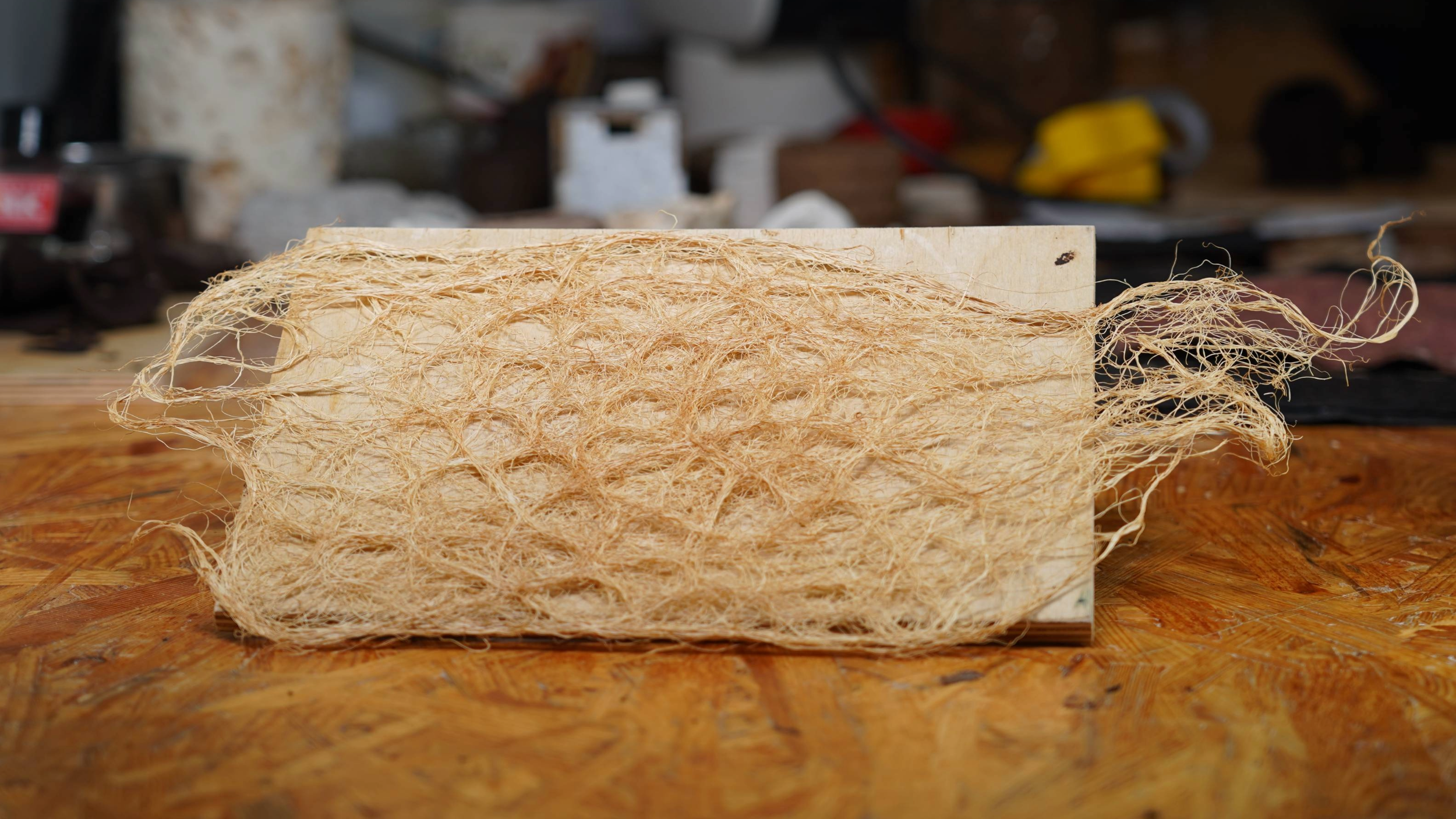
Before having the tray sets, I harvested some freely-grown roots and arranged them around the 3D-printed pattern to bake them. They did turn out into the pattern, but the structure was more than fragile.
I also tried with making wheatgrass paper with the unwanted grass. The instructions can be found in another post.
Acknowledgements
Last but not least is the inspiration and references.
Zena Holloway and Diana Scherer are two artists that inspired me to start experimenting with making fabric with plant roots. They both created some large scale, truly amazing projects with wheatgrass roots!