

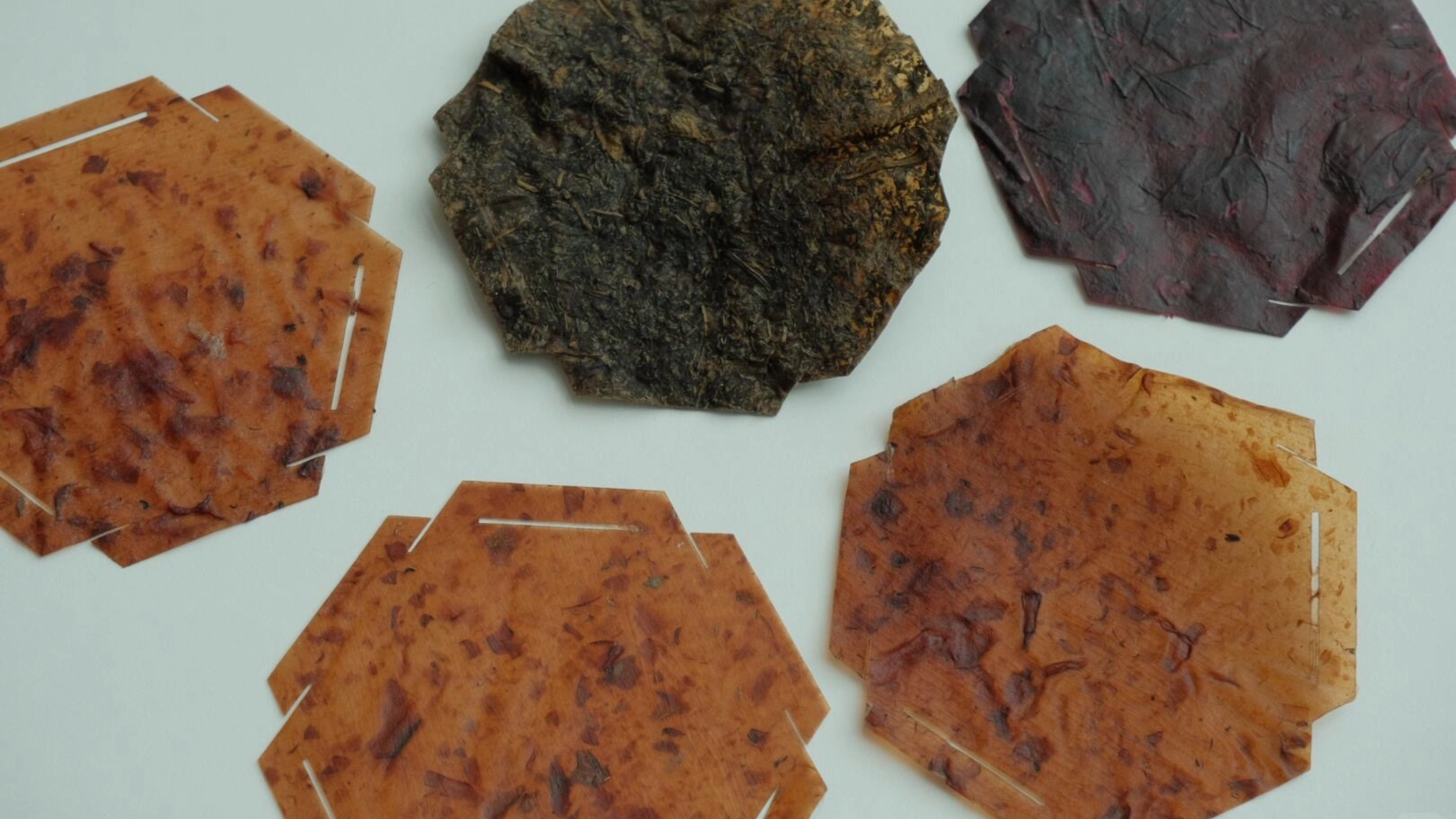


This recipe/ bio-leather sheet was the result of several experiments I made during the summer of 2024, when I was working on the second iteration of my interactive fashion project.
The glycerin was added to minimize the shrinking of the sheet, I suppose. And the reason why I added petals and leaves to the mixture was that, it was right after the Qingming Festival and there were so much almost-dried wormwood (艾草) left in my place. Out of curiosity, I shredded the leaves into pieces with a small mixer, and it turned out well. Later, because my mom kept flowers, I brought her unwanted flowers to the lab and worked with the flower petals too. It was a fun experiment as the flower petals and leaves added unexpected color to the bio-leather.
Adding these materials into the mixture did result in the final bio-leather to shrink significantly sometimes, or to have uneven thickness. I tried with heat-pressing the sheet in-between the baking paper. The result wasn’t unsatisfactory, but heat-pressing didn’t help with flattening the sheet much. (One thing to keep in mind is that DO NOT heat press when the sheet isn’t completely dried. I think some part of the sheet got stuck on the baking paper once!)
Laser cutting
Since we didn’t have a huge space for casting the bio-leather, nor did we have a container large enough, I made sheets and sheets of bio-leather, and was trying to find ways to connect them. (I wasn’t good at using the sewing machine so that option didn’t work out for me.) When researching online, I found a hexagon pattern adopted by interior design that seemed very feasible. At first I experimented with paper, and I found out hexagon is the most secured structure. (The pattern on the right was too fragile, please do not refer to that one. The one on the left worked better)

In order to laser cut, remember to tape the sheet onto the machine, and put the material setting as “paper”. Afterwards, all you need to do is to interlock the patterns very carefully with each other! 🙂
Further development
I didn’t measure the amount of plants added to the mixture, nor haven’t I experimented with completely dried plants. Maybe the size of the plant pieces matters too. Having these taken into consideration will definitely yield to more ideal bio-leather production.
Additionally, I am also curious about the feasibility of sewing the bio-leather together. Maybe the bio-leather is too brittle, thus having holes on it isn’t an ideal way of connection. But it is also possible that the bio-leather has the flexibility to be connected in such a way?


